Month December
-
Bhagavan’s Jayanthi
Bhagavan Sri Ramana’s birth anniversary is called Jayanthi day and it is celebrated
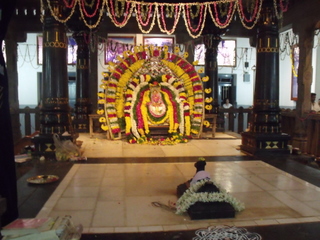 every year in the Ramanashram in a very splendid way. This year it fell on 22nd December. Early in the morning after the Dhanur Maasa puja there was special chanting of Arunachala Shiva followed by chanting of Tiruvempavai and Vishnu Sahasranaamam. Then there came the breakfast interlude. After this, the grand puja celebrating the special event was begun on the shrine of Sri Ramana’s Samadhi. This Ekadasa MahaRudra puja was performed on an elaborate scale by the priests and went on for a few hours. After the finishing Arathi, devotees were invited to partake of the sumptuous lunch Prasad meal and there was quite a scramble to get in front of the food queue. In the evening, there was a music concert by the Amritavarshini troupe from Bangalore singing their same collection of Ramana songs as they do every year.
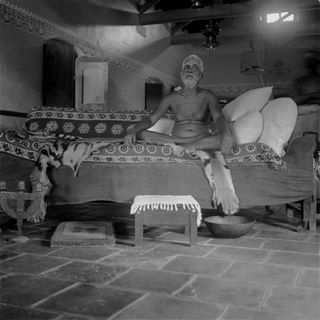 In Letters from Ramanasramam on 24th February 1947, Bhagavan is supposed to have narrated the following incident in connection with celebrating his birthday: “On one of my birthdays while I was in Virupaksha cave, probably in 1912, those around me insisted on cooking food and eating it there as a celebration of the occasion. I tried to dissuade them but they rebelled saying. ‘what harm does it do to Swamiji, if we cook our food and eat it here?. I therefore left it at that. Immediately after that they purchased some vessels. Those vessels are still here. What began as a small function has resulted in all this paraphernalia and pomp. Everything must take its own course and will not stop at our request. I told them at great length, but they did not listen. When the cooking and eating were over, Iswaraswamy who used to be with me in those days, said, ‘Swamiji ! this is your birthday. Please compose two verses and I too will compose two.’ It was then that I composed these two verses which I find in the notebook here. They run as follows :
- You who intend to celebrate the birthday, first ascertain as to whence you were born. The day that we attain a place in that everlasting life which is beyond the reach of births and deaths is our real birthday.
- Even on these birthdays, that occur once a year, we ought to lament that we have got this body and fallen into this world. Instead we celebrate the event with a feast. To rejoice over it is like decorating a corpse. Wisdom consists in realizing the Self and in getting absorbed therein.
This is the purport of those verses. It appears that it is a custom amongst a certain
 section of people in Malabar to weep when a child is born in the house and celebrate a death with pomp. Really one should lament having left one’s real state, and taken birth again in this world, and not celebrate it as a festive occasion.”
continue reading
-
Arudhra Darshanam
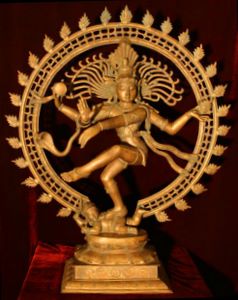
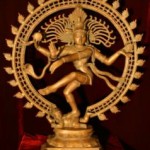 Arudhra Darshan is a very important festival dedicated to Lord Shiva Nataraja. It falls in the tamil month of Margazhi which begins in mid December and goes upto mid January. It is on the full moon night of the Arudhra (Orion) constellation that Lord Nataraja is believed to perform his cosmic dance and thus He upholds the five-fold activities of the universe. Arudhra signifies the red flame and Shiva performs his dance in this red-flamed light.
The cosmic dance of Lord Shiva represents five activities – Creation, Protection,
 Destruction, Embodiment and Release. In essence, it represents the continuous cycle of creation and destruction. This cosmic dance takes place in every particle and is the source of all energy. The Arudhra Darshan festival celebrates this ecstatic dance of Lord Shiva-Nataraja, the Cosmic Dancer.
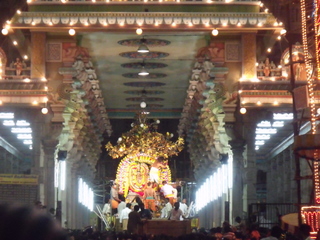
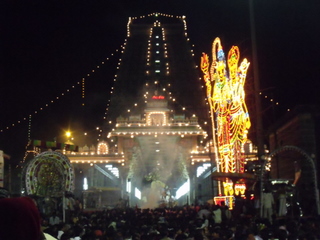 This year Arudhra Darshanam in Tiruvannamalai takes place on the full moon night falling on 22nd December. Millions of people will walk around the holy hill of Arunachala. In the big temple of Lord Arunachaleeswara, Arudhra is celebrated as a Nataraja Utsavam and there will be many special pujas and rituals involving sacrificial fires and grand abhishekams to the deities of Lord Nataraja and his consort Goddess Shivakami.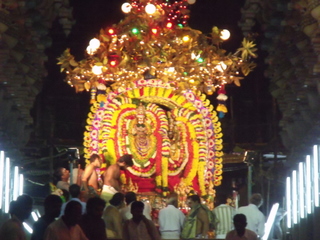
For Ramana devotees it will also be a special day because it marks the preceding night of Sri Ramanas birth anniversary which one may remember, happens on the next day.
continue reading
-
Sama Veda chanting
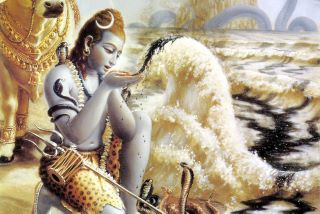 The Sāmaveda, (in sanskrit sāman means melody and veda means knowledge), is the second of the four Vedas. Its earliest parts are believed to date from 1700 BC and it ranks next in sanctity and liturgical importance to the Rig veda. It consists of a collection of hymns, portions of hymns, and detached verses, all but 75 taken from the Sakala Sakha of the Rigveda, the other 75 belong to the Bashkala Sakha, which are to be sung, using specifically indicated melodies called Samagana, by Udgatar priests at special Homas and Yagnas, in which the juice of the Soma plant, clarified and mixed with milk and other ingredients, is offered as propitiation to various deities.
The Sama Veda is the Yoga of Song. It consists of various hymns of the Rig Veda put to
 a different and more musical chant. Its secret lies in its musical annotation and rendering. The Sama Veda represents the ecstasy of spiritual knowledge and the power of devotion. If the Rig Veda is the knowledge, then the Sama Veda is its realization.
 Lord Shiva is believed to be a great fan of the Sama Veda chanting and in the epic Ramayana, Ravana gains the special favour of Lord Shiva by singing the Samaveda ganas to him while playing on his veena. This is how he was able to have so much power and create havoc in the life of Lord Rama.
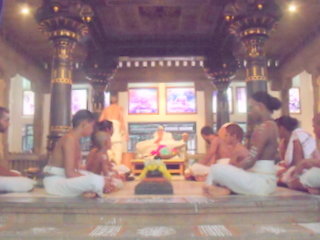
During the recent Karthigai Brahmotsavam, the Ramanashram hosted a group of Samaveda Udgatar priests from Kerala who rendered an excellent chanting of selections from the Samaveda, every afternoon,
 for all the ten days of the Utsavam. Devotees both indian and western listened to this chanting and found that the sounds were most conducive to their mediative practices.
continue reading
-
Deepam in Ramanashram
 People may wonder how Deepam was celebrated when Bhagavan was alive. Here is an account of it by Suri Nagamma in Letters from Ramanasramam:
In the afternoon from 3 o clock onwards the devotees started making preparations for the festival. At the Asramam the floor was decorated with lime and rice powder, floral designs and mango leaf festoons. On such occasions the crowds which come to town for this festival usually visit the
 asramam in the morning as they go round the Hill, whereas in the evening it is mostly the Asramites who are present at the Asramam celebrations…
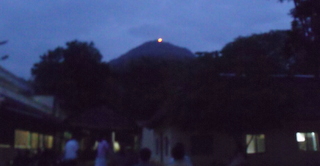
On this evening when Bhagavan went out the attendant placed his couch in the open space facing the summit. Opposite the couch a large shallow iron pan was placed on a high stool, ghee poured into it and a wick placed in the centre. We then sat in rows, the men on Bhagavan’s right and the women on His left. The space in front of Bhagavan was filled not only with baskets of flowers but also with vessels of all sorts of sweetmeats and other preparations. When the ghee brought by the devotees was poured into the pan for
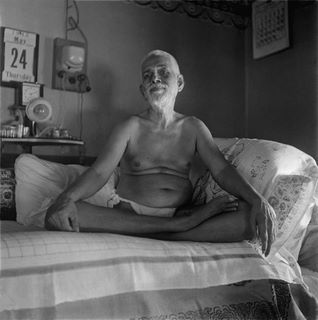 kindling the light, the pan was overflowing. Camphor was then placed on the wick. The fragrance from the lighted incense sticks spread on all sides and created a holy atmosphere. Bhagavan sat lovingly looking at all the devotees and related to those near Him the significance of the festival of Light. He also pointed out the exact place where the light was to be kindled at the top. Everyone was eagerly awaiting the lighting of the sacred beacon on the Hill top. While His gaze was concentrated on the summit of the hill, ours was concentrated on His divine face, for it was just a reflection of Arunachala. With the firing of crackers at the temple, the light on the Hill top appeared. Immediately the Akhanda Jyothi (perennial light) opposite Bhagavan was lit. The brahmins rose and chanted the mantra, “Na karmana na prajaya dhanena” and lit the camphor. After Bhagavan had partaken of a little fruit and some sweetmeats, the rest were distributed amongst the devotees. Immediately after that the devotees divided themselves into
 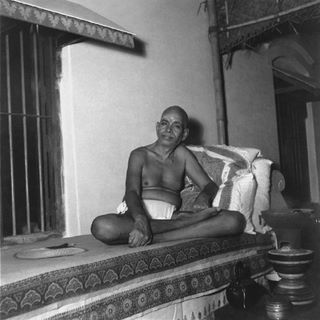 two groups, singing the hymn Aksharamanamalai. After that, the five stanzas beginning with “Karunapurana Sudhaabhde” in Sanskrit and its equivalent in Tamil were recited. Bhagavan sat resting His cheek on His hand, His characteristic pose. His face appeared as though mirroring His Self-Illumination, what with His silence and His profound thought reflected on it. The moon rose in the East and cast its light on Him as though seeking its light from Him…
continue reading