Month September
-
Arunachala Panchamukham
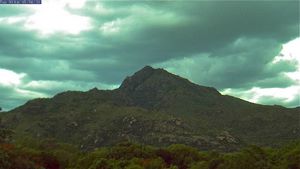
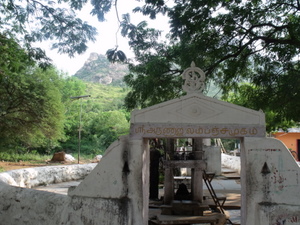 When one walks along the outer giripradakshina path, about a hundred metres after the Kubera Lingam shrine, one can see on the right a curious shrine with five small Shiva Lingams on a raised pedestal circumscribed by a round stone platform. It is titled Arunachala Panchamukham in tamil old-fashioned script. If one looks at the mountain from this point there are distinctly five peaks visible with very beautiful contours. This is called Panchamukham – the five faces. The five peaks here represent the five aspects of Lord Shiva viz., Satyajotam, Vamadevam, Tatpurusham, Eesanyam and Aghoram. And a giripradakshina cannot be complete unless one has taken dharshan of the Panchamukham.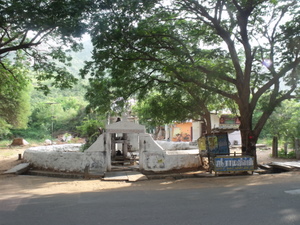
A devotee recalls, “Near the Panchamukham, at sunrise or sunset, especially during the winter months, the sun’s rays pierce the mist and spotlight the peaks. The interplay of light and shade creates patterns, highlighting the transcendental beauty of the outline of the hill. The successive peaks split the light into ribbons that trail off. The interspersing light re-emerges, exhibiting the majestic and imposing
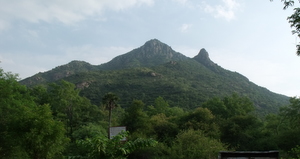 splendour of the Lord in all His glory…”
Today, unfortunately the view of the Panchamukham is marrred by the construction of an ugly modern concrete structure, supposedly a shrine for Goddess Durga. One wonders if She would at all be
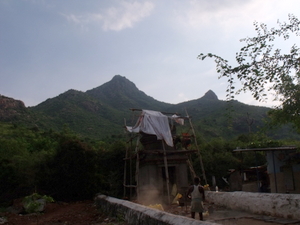 happy to have a temple that actually spoils the sacred beauty of this revered spot!
continue reading
-
Ganesha Chathurthi
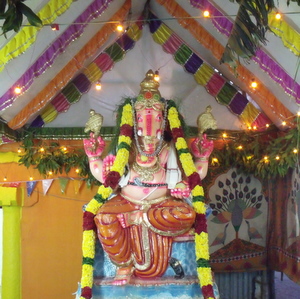 Hindus believe that Lord Ganesha is the God who has the power of removing all obstacles and making one’s path clear whether it be worldly or spiritual. Any new undertaking, either at one’s place of work or at home, always starts by reciting a mantra invoking his blessings. He is also known as the God of good luck and prosperity. Ganesha Chathurthi, which is the birth anniversary of Lord Ganesha, is celebrated in a grand manner all over India and in Tiruvannamalai too. This year, Ganesha Chathurthi fell on the 11th of September and in the Sadhu Mandapam opposite Agni Theertham, a spectacular Ganesha of giant proportions was installed and worshipped with great pomp and splendour.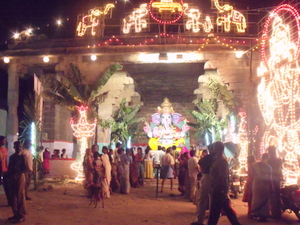
The most popular legend associated with Lord Ganesha can be found in the Shiva Puranam. Here it says that Lord Ganapati was created out of the dough that Goddess Parvati used for her bath. The Goddess wanted a gate-keeper, to keep visitors away while she took her bath. So She created a male doll from the dough and breathed life into it. The day she did this came to be known as the birthday of Lord Ganesha, which we celebrate today as Ganesh Chathurthi.
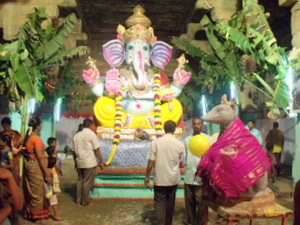 One day while Goddess Parvati was taking her bath, Lord Shiva came to visit her. Ganesha did not know him, so he did not allow the Lord to enter the house. This made Lord Shiva angry and he cut off poor Ganesha’s head. Later, when he came to know the truth, he replaced Ganesha’s head with the head of an elephant. After this, the appearance of Lord Ganesha changed and he became the elephant-headed god.
There is yet another popular legend associated with Ganesha Chaturthi, from Skanda Puranam. Here it says that once Ganesha was invited for a feast in Chandraloka (the Moon’s abode). Our Ganesha being quite fond of sweets, ate Laddoos till his stomach bloated, so much so that as he got up to walk after the meal, he could not balance himself because of his huge stomach and he slipped and fell. His stomach burst and all the laddoos came rolling out. Seeing this, the Moon was highly amused and burst out laughing. Ganesha got angry and cursed the Moon that it would vanish from the universe.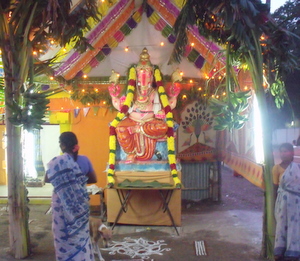
Because of the Moon’s disappearance, the whole world began to wane. The gods asked Lord Shiva to get Ganesha to revoke his curse. The Moon also apologized for his misbehavior. Finally, Ganesha modified his curse saying that the Moon would be invisible only on one day of the month and would be partially seen on Ganesha Chaturthi. He also added that anyone who looked at the moon on Ganesha Chaturthi would face a
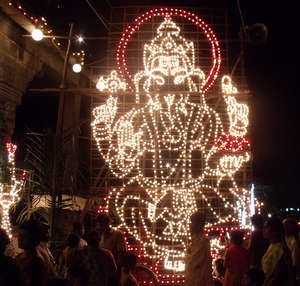 false charge. This is the reason why, even today, it is considered inauspicious to look at the moon on Ganesha Chathurthi.
continue reading
-
Pavala Kundru
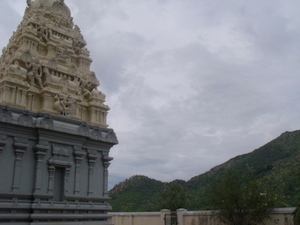 The Pavala Kundru temple is dedicated to Lord Ardhanareeswara (androgynous form of the Lord as Half Shiva – Half Parvathi). It is here that Parvathi performed Tapas to regain the favour of her Lord Shiva. He then appeared to her and absorbed her into himself and thus the two became one. This is how Ardhanareeswara was born. There are not many temples dedicated solely to Ardhanareeswara and this is a rare and special temple though relatively unknown.
Bhagavan Ramana stayed here in the year 1899 and granted spiritual
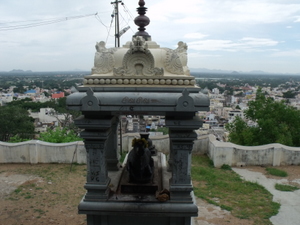 instruction to his mother inside this temple. The mother is said to have been transformed into a deep spiritual being since then and devoted her life to serving her son in Tiruvannamalai itself whereas before she used to try to persuade him to return to the parental home in Madurai.
Pavala Kundru (coral rock) is situated on the eastern spur of Arunachala. It
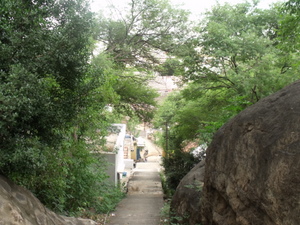 earns its name because the rays of the rising sun are supposed to turn the whole rock to a lovely coral red. This less-known temple can be approached from the town through a little street leading off the Durgai Amman Kovil road about a kilometre after the main bus depot. There is a good stone staircase hewn against the rock to climb up to the temple.
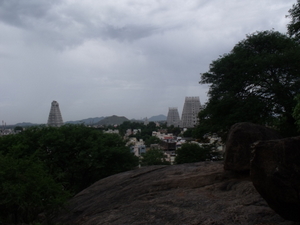 Once you reach there, you don’t hear the noise of the town anymore and it is
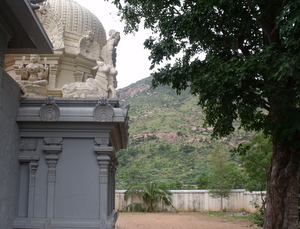 thus an ideal spot for meditation because it is almost totally deserted and set in a quiet and peaceful spot with an abundance of natural flora and fauna. There is a huge old banyan tree right beside the temple and one can sit underneath and have a view of the hill on one side and the temple towers on the other which is indeed a rare sight.
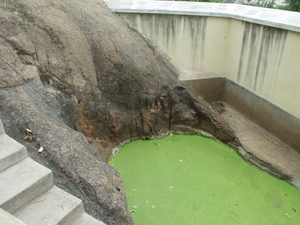
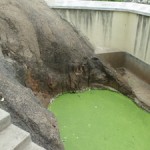 The theertham for the temple is a pretty green natural pond inside a niche in the outhanging rocks and it has water all through the year even in hot summer. There are little steps leading down to it and the priest goes in daily to collect water for the pujas.
The Ramanashram deserves credit for having renovated this
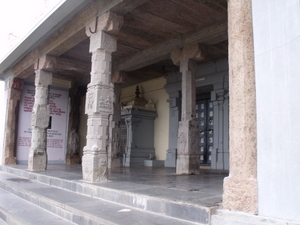 temple which was falling into ruins. The renovation has been done correctly, respecting and preserving the ancient architecture, without destroying the old stone work and the minimal use of concrete. It would be good if other shrines on the girivalam would also emulate this method of respecting the past in their over-zealous renovatory work.
continue reading
-
Advent
In the western world, Advent refers to the period preceding Christmas connected to the advent of Christ but here in Arunachala, Advent always refers to the day on which the great Sage of this epoch, our very own Bhagavan Ramana entered the sacred town of Tiruvannamalai.
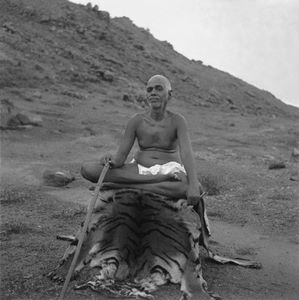
In the year 1896, on the first of September, Sri Ramana as a young lad of sixteen, arrived at the feet of the Holy Mountain. About a month earlier, in mid-July, he had already had his first death-experience and attained the highest truth which he called later as Self-Realisation. After this he became indifferent to his boyhood life, studies, play etc and began to seek solitude. For this, his elder brother taunted him and the young boy Ramana understanding the truth behind his brother’s rebuke, left his parental home leaving a note that he was going in search of his father. With this farewell note he left Madurai for ever.
Right from the time he left his house, a series of miracles took place and Arunachala mysteriously guided the youth to his final destination. It was Arunachala who delayed the train’s departure so that Ramana could board it and later on appeared in the form of a Maulvi in order to give the lad directions to reach Tiruvannamalai and then, lo and behold, actually granted divine dharshan to the boy in the form of a column of effulgence in the temple of Ariyanainallur.
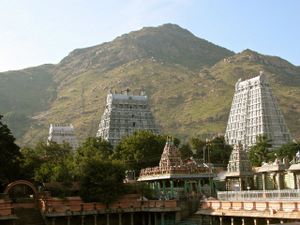 Not many people know that the doors of the Arunachaleswara temple which were closed habitually at the time of his arrival, started to open one by one of their own accord just as Sri Ramana entered. Indeed is there any doubt left that the Son had thus returned to his Father’s house?
Who can describe what Ramana felt when he saw the Hill for the first time? In his own words: “I came up here and saw, and found thou stood as a Hill, But who then is the seer … no seer then remained. No mind survived even to say that I saw this, or even to say I didn’t.”
This year on September 1st in Ramanashram, the Madurai Ramana Kendra conducted a series of parayanams (religious chanting) at the Samadhi shrine and at the Mothers shrine, as a way of commemorating Advent. Devotees participated in the chanting and thanked the Gods for bringing them to the Abode of the great Master whose Eternal Presence continues to thrill millions…
continue reading
-
Girivalam shrines – Snake worship
Snake worship is an ancient and widespread religious practice in India. The
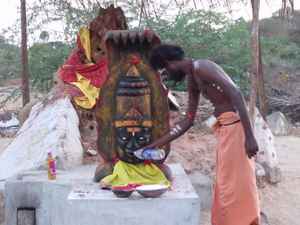 Cobra is associated with the Lingam, the emblem of Lord Shiva. The Nagarpanchami snake festival is celebrated by many Hindus. On this day, people worship snake gods with flowers, milk and eggs in front of their idols in temples. Innumerable shrines containing images of the snake king Vasuki bear eloquent testimony to the influence of the Serpent on the social and spiritual fabric of India.
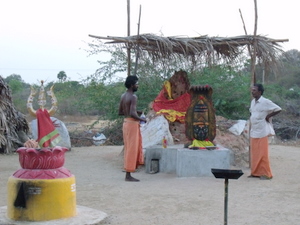 Here in Tiruvannamalai too, there are many termite mounds which are considered to be the dwelling place of serpents and hence venerated as snake temples. The most recent snake shrine is a huge termite hill on the left side of the outer Girivalam path a few metres after the Draupadi temple. Within a short time this temple has become quite popular and the resident serpent goddess has been christened “Nagathamman” (Naga means snake in Sanskrit).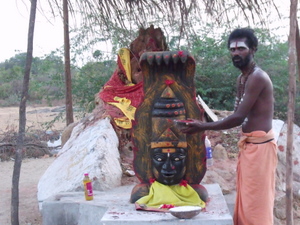
In Hindu mythology we come across several episodes involving serpents. When the ocean of milk was churned for the recovery of ambrosia, the snake king Vasuki served as a rope and was tied around Mehru mountain. The poison ‘HalaHala’ which emerged from the ocean prior to the arisal of the nectar, was in danger of engulfing the whole universe. But Lord Shiva bravely consumed the poison emitted by the serpent and thus saved the universe from destruction. Due to the effect of the poison his throat became dark blue in colour. For this reason, Shiva has the name of NeelaKantha (the Blue-throated One).
continue reading