Month August
-
Aadi Puram
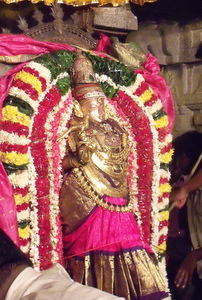 The tamil month of Aadi (sanskrit = Aashaada) has drawn to an end and the Goddess Shakthi to whom the whole month is dedicated is probably taking a much-needed rest after the frenzied rituals and celebrations with which she has been bombarded during all this month.
The culminating festival in her honour is the feast of Aadi Puram which falls on the Puram constellation. This year it was celebrated on August 12th and in the big temple of Arunachaleswara, there took place a grand religious and devotional extravaganza on this day.
In the evening, the Goddess Parashakthi is brought to the valaiyal kappu mandapam in the 5th courtyard. Here first the Goddess is worshipped with a grand abhishekam. Then She is beautifully adorned in a silk sari and decked with golden ornaments and flowers. After this a long queue of women devotees offer bracelets and bangles (valaiyal) to the Goddess. The priest places the bracelets on Her arms and then returns them to the women as prasad. Rudram is chanted by the Vaidikas all the while.
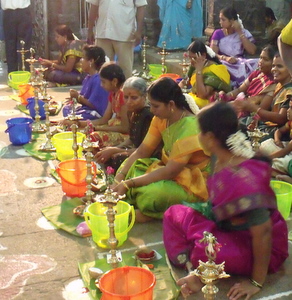
This Valaiyal kappu (protection with bracelets) ceremony is traditionally performed for preganant women in their 8th or 9th month. On Aadi Puram, this ceremony is performed to the Goddess as it is a general belief that She is at this time expecting the birth of Muruga or Subramanya, the second son of Shiva and Parvathi.
However the logic which underlies the sequence of the rituals of Aadi Puram is quite enigmatic. Whereas the the ritual of valaiyal kappu is especially to protect the woman who is in an advanced stage of pregnancy, in the next ceremony after this, the Goddess is treated as a young virgin woman about to get married and receives the
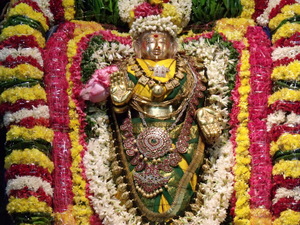 offering of a Thali, the traditional ornament of marriage. There seems to be in the celebration of Aadi Puram, an effect of condensation of all that the Goddess represents. This is amplified by the local cults of the Aadi month and the connection to Durga and is completed in the ensuing months with the Navaratri festival in autumn and the Karthikai festival in winter.
continue reading
-
Girivalam – Thiru NerAnnamalai shrine
 The Ner Annamalai temple is found on the outer girivalam path about 1 km after the Shanthimalai ashram. It is located on a charming hillock just bordering the forest leading to the inner path.The shrine earns its name because the deity Annamlai inside faces the Arunachala hilltop directly (Ner in tamil means straight or direct). The temple mandapam is a hallowed spot for the sadhus and they gather here almost daily to sing and chant verses in praise of Arunachala.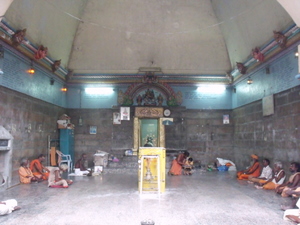
The Arunachala sthala purana (verse 392) hails this temple as being the reason for the giripradakshina practice. According to legend, Parvathi at one time having lost the favour of Shiva comes here as Unnamulai Amman and performs penance to regain the favour of her Lord. But still the Lord refuses to appear. Undaunted she starts to walk around the hill barefoot (giripradakshina) and it is at this spot that the Lord appears and re-unites with her. And thus the
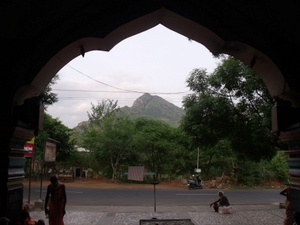 first giripradakshina was performed by the Divine Mother Herself!
On Karthigai Deepam day, simultaneously with the lighting of the Holy Beacon on the Mountain, a Deepam is always lit in this shrine also, to the loud chantings of Annamalaiyarukku Haro Hara. Twice in the year, on the auspicious day of Tamil New Year in April and then on the sacred day Krishna Jayanthi in August, the Sun rises directly in front of this temple and shines his rays fully on the Annamalaiyar Lingam inside the Sanctum Sanctorum. Behind the temple is an enormous Theertham with a great sunset view.

There is also a shrine to the Goddess UnnamulaiAmman beside the Lord’s shrine. Inside there is a very lovely statue of the Goddess where she stands gracefully, beaming at her devotees with infinite compassion. The Alamkaram to the Goddess are of particular
 beauty and taste and one cannot but stop and admire her royal attire and adornments as one passes by even on a daily walk…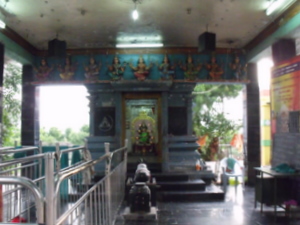
continue reading
-
Amman Kooluthal festival
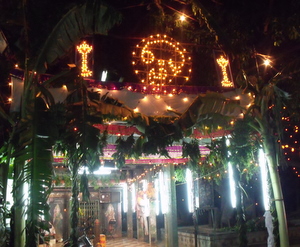 In the month of Aadi (July-August), which is devoted to the Mother Goddess (Amman), there is a popular rural celebration in Tamil Nadu called the Kooluthal festival. Kool is a type of gruel made of fermented ragi batter and at this time, each family prepares a pot of Kool and offers it at the local Amman temple where it is poured into a huge cauldron and offered to the
  resident Goddess (usually MariAmman, a rural form of Parvathi). This is then distributed to one and all as Prasad. During the festival, the whole main street from the temple is
 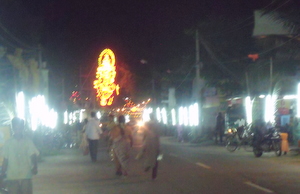 decorated with banana and palm fronds and shiny coloured lights are strung everywhere. There are also enormous lighted cut-outs depicting the Goddess which blaze at night and strike the attention of every passer-by.
This week in the village of Adi Annamalai, the Kooluthal festival was celebrated on a
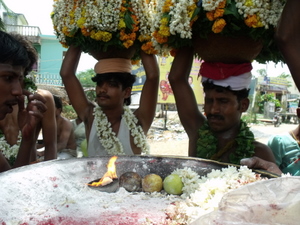
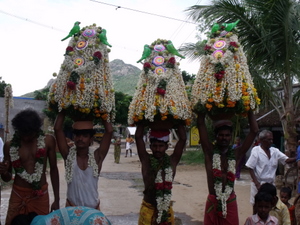 grand scale. The morning after the distribution of the Kool, the ritual with the karagam dancers was performed. This involves a group of male dancers, some with flower-decorated pots balanced on their heads, musicians of three sorts, a few with drums, some others with waving cymbals and more others with
 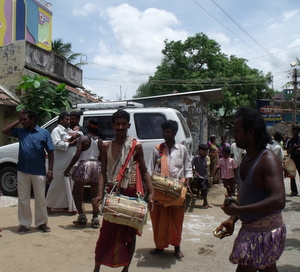 bells tied around their feet and brass rings in their hands. This group makes a tour of all the streets in the village. The ones with the pots on their heads are considered to be embodiments of the Goddess and are worshipped by each family with women washing their feet with pots of water, applying turmeric and vermilion on their feet and then prostrating on the ground in front of them.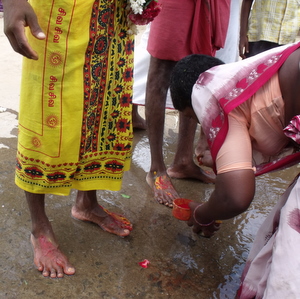
In the evening, the Goddess is brought out in procession and fireworks are set off. Later that night there is much fun and merry-making among all the people. Film shows, dramas and other entertainment shows take place in the ground outside the temple and the rural folk relax and enjoy themselves.
This is the time of year when summer is drawing to an end and the first rains have arrived. People are relieved that the great heat
 is over and that they can start the next season of cultivation soon. It is a time of hope. The Goddess is propitiated with the belief that the rains will be bountiful and that they would reap a good harvest and have prosperity in their lives with Her blessings.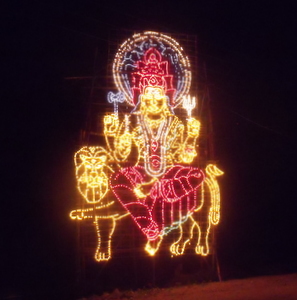
continue reading