Month July
-
Guru Purnima
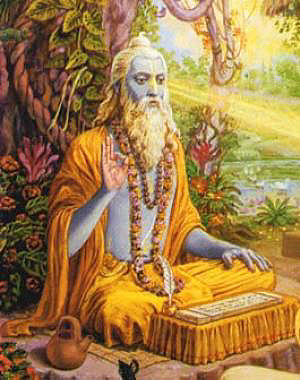
 The full moon which appears in the Hindu month of Aadi (Aashada) (July-August) is observed as the auspicious day of Guru Purnima, a day sacred to the memory of the great sage, Vyasa. Indeed, we are all indebted to this ancient saint who edited the four Vedas, wrote the 18 Puranas, the Mahabharata and the Srimad Bhagavata.
On this day, all spiritual aspirants and devotees worship their guru and all disciples perform a ‘puja’ to their respective spiritual preceptor or ‘Gurudeva’.
Moreover, this day is of great importance to the farmers, for it heralds the setting in of the much-needed monsoon rains, as the drenching of the cool rain on the earth after the hot summer makes everything grow and become green and lush again. It is also considered as a very beneficial time for all spiritual practices. Traditionally, spiritual seekers are taught to intensify and take seriously their spiritual ‘sadhana’ from this day.
 The period ‘Chaturmas’ (“four months”) starts on this day. In puranic times, this was the period when wandering spiritual masters and their disciples used to settle down at a place to study and discourse on the Brahma Sutras composed by Vyasa, and engage themselves in Vedantic discussions.
In Tiruvannamalai, the spiritual centre of the universe, millions perform giri pradakshina and walk around the holy mountain Arunachala with the earnest hope of gaining spiritual wealth from the Guru of Gurus, the timeless embodiment of the Self in the form of an earthly mountain. May we all surrender to his Holy Feet on this Guru Purnima and realize the true Arunachala who shines in the depth of every heart!
continue reading
-
Girivalam – Palani Andavar kovil
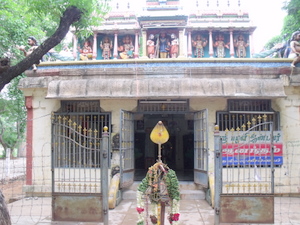 The Palani Andavar kovil is found on the outer girivalam path opposite the now derelict Echo mandapam. It is a temple dedicated to Muruga, the second son of Shiva who is the main god of the Tamils. The name Palani is derived from the region of Palani on the western ghats mountains where Muruga is believed to have become enlightened and manifests there as a naked young boy smeared with ashes, Palani Andavar, the Lord of Palani.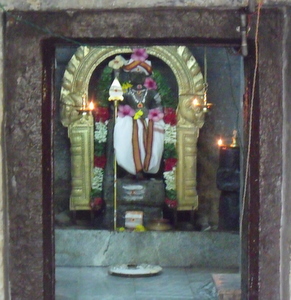
The legend of this Palani temple on the girivalam is that Bhringi Maharshi is supposed to have undergone tapas at this spot and Muruga appeared to him there as Palani Andavar and granted him liberation (Mukthi).
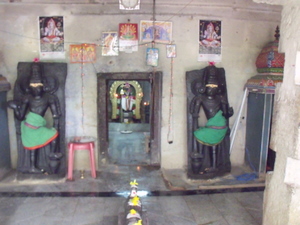
Today it is quite a popular shrine for local tamils. A loudspeaker blares bhajans all day long and coloured serial lights glitter at night . The saving grace is the magnificent old Peepul tree beside the temple with lush green
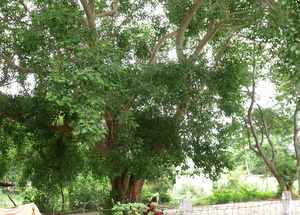 foliage and a multitude of birds singing away. One can sit underneath this tree and enjoy the holy energy of this place more than in the temple mandapam which seems to have become an extended living quarters of the resident sadhu priest !
continue reading
-
Dakshinayanam
 The term Dakshinayanam literally means southern journey. Here it refers to the Indian Summer solistice, for in hindu puranic yore the Sun is believed to move towards the South at this time. It seems to accentuate the idea that we are entering the darker part of the year – less sun, more rain, longer nights…
As Arunachala is also revered as the Sun mountain, events involving the Sun are always celebrated here as a festival.
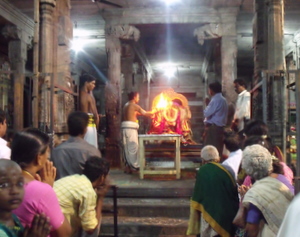
The Dakshinayanam festival begins in the big temple exactly 10 days before the summer
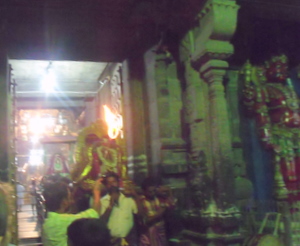 solistice which, in India, falls around the 17th of July. It takes place on the usual course of an Utsavam (temple festival). Even though the meaning of the festival is not very explicit, one can eventually glean the cosmic dimension in it, for, at this time of year such a festival seeks to define the auspicious period in which the idea of death leading to ascension is highlighted in a most subtle way.
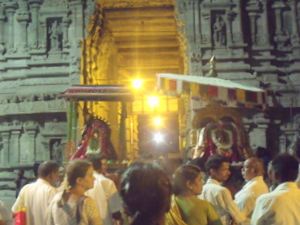
Each day in the morning around sunrise and in the evening around sunset the different gods of the hindu pantheon are taken out on procession. The yagasala is opened since the first day and two kalasams representing the Sun
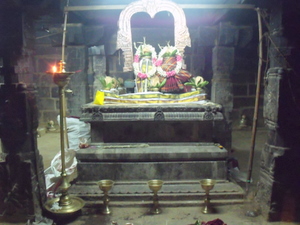 (Surya) and his wife, Chaya (the Shadow) are venerated according to vedic rituals for the first 9 days. On the 10th day, at the culmination of the festival, the kalasams are brought outside on procession with the gods and taken inside the main shrine for bathing the deities.
The main difference between the Dakshinayanam and the Uttarayanam (Northern Journey – winter solisice festival) is the place accorded to the Tiruvoodal (divine quarrel). Whereas it stays as a private affair now and is only performed within the walls of the
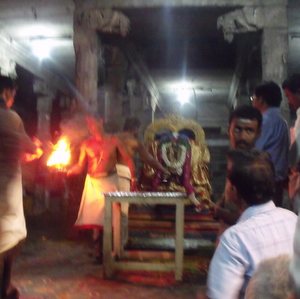 temple shrine, at Uttarayanam, the Tiruvoodal is a public affair and taken right to the streets and enacted in the view of the public. One wonders why and the answer is “even the Gods like to keep their affairs in the dark at this time!”
continue reading
-
Legends of Arunachala – 1
There are many legends and interesting tales which are recited about Arunachala and here is one that speaks about the supreme blessing that one receives by coming here.
In puranic times, Markendaya an ardent devotee of Lord Shiva, who was granted eternal life due to his devotion, asked Nandi, the bull-mount of Shiva, “O Nandikeswara, please tell me which is the place where true knowledge can be acquired without rituals, book learning or elaborate religious practices, where even an ignorant person can attain enlightenment by merely smearing sacred ash on the forehead, where all residents overcome obstacles and attain the Supreme Knowledge without any conscious effort, where even the worst of men, the lowest of animals and inanimate objects attain perfection ?” In response Nandi starts to describe in detail all the places on earth sacred to Shiva… But Markendaya is not satisfied and cunningly asks Nandi again, “O Nandi, all this i already know. Of course each of these sacred places has its speciality but which is the sacred spot that thas the totality of the benefits of all the sacred places? Please tell me the name of the one place by remembering which even once, knowingly or unknowingly, all beings, moving as well as immobile can obtain liberation?” According to Arunchala purana, Nandi, at this point, thinking of Arunachala, became esctatic and went into samadhi. With tears streaming down his eyes and voice hoarse with emotion, Nandi says, “yes there is such a place, it is ARUNACHALA, the embodiment of Lord Shiva”.
Since then, during every yuga, Arunachala has drawn numerous saints to its lap and without doubt, in this kaliyuga, Arunachala Himself deigned to take a human form as Sri Ramana Maharshi and showered the world with his grace and silent teaching. Blessed are we indeed to live at his Holy Feet!
continue reading