Month June
-
Girivalam shrines – Pachaiyamman Kovil
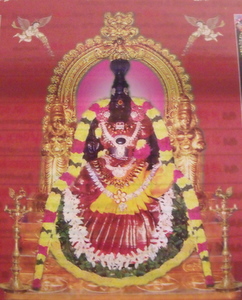
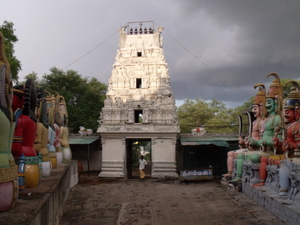 At the end of the inner giri pradakshina path as one approaches the town, one comes upon the ancient temple of the Goddess Pachaiyamman. This is where Bhagavan Ramana resided during the plague epidemic and this is where the tiger used to come and visit Him, announcing its arrival with two loud roars that would send the disciples fleeing in terror while Bhagavan remained undaunted and granted dharshan to the royal animal.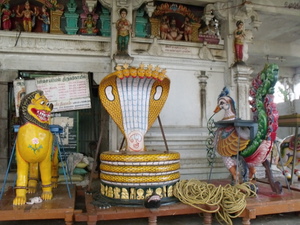
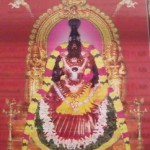 Goddess Pachaiyamman is a manifestation of Shakthi, and it is here that she is believed to have done tapas during puranic times to be united with Shiva in one form. It is believed that Shiva appeared here and integrated Her in the left half of His body and thus Lord Ardhanareeswara was created.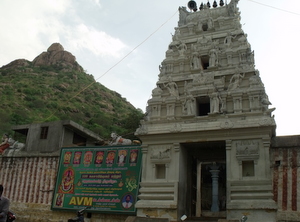
This temple is situated in an idyllic spot on the hill surrounded by beautiful old banyan trees where birds sing all day long and langur monkeys prance about. There are three perennial theerthams
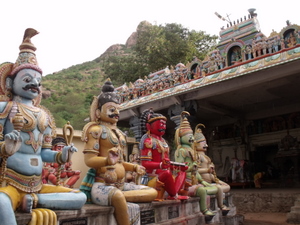
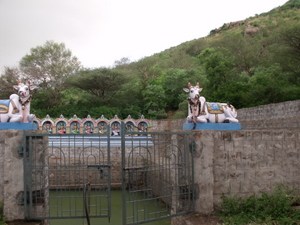 with lovely cool green waters and the water in the main one is used for the god’s abhishekams. The entrance path to the temple is flagged by enormous Muniswara statues (tamil guardian
 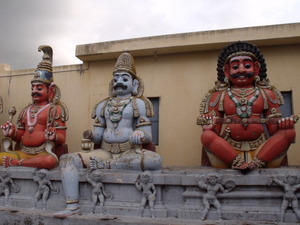 deities) and it is very impressive to see them gazing down upon you with their huge eyes as you walk inside.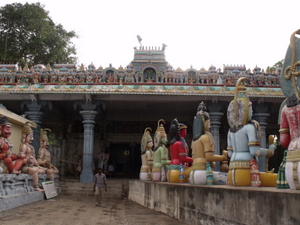
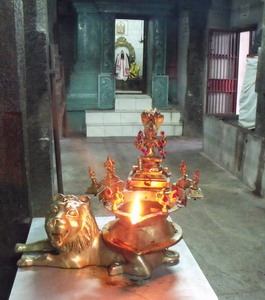
Inside the sanctum sanctorum, the Goddess sits in a benign attitude and you cannot but feel her compassion and grace flowing into your heart as you take dharshan. Pachai Amman means the Green Mother and she is named thus to signify her fertility and also because, according to legend, the Dharba grass which is usually yellow, turned completely green as she walked over it in her tapas.
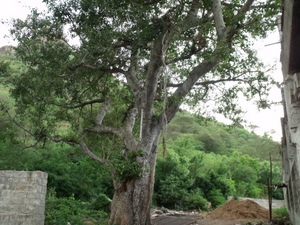 An inner giri pradakshina can be quite difficult as the hilly path is stony and hard. However, devotees feel well rewarded to come upon this temple after the arduous walk and take repose in the Green Mother’s
  arms.
arms.continue reading
-
Aani Thirumanjanam
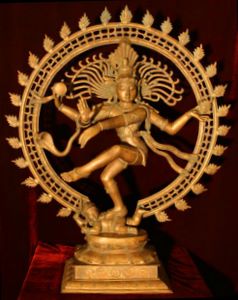
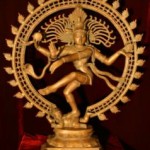 Nataraja, the Lord of Dancers is the cosmic form of Lord Shiva (In Sanskrit, Nata means dance and raja means Lord). The ring of fire and light, which circumscribes the entire figure, identifies the field of the Lord’s cosmic dance encompassing the whole universe. The lotus pedestal on which the Lord rests, locates the universe in the heart or consciousness of each person.The Nataraja figure is also eloquent of the paradox of Eternity and
  Time. It explains that the tranquil ocean and the rushing stream are not finally different. Shiva is Kala, meaning time, but he is also Maha Kala, meaning “Great Time” or eternity.
 Shiva is thus two opposite figures: the archetypal ascetic and the archetypal dancer. On the one hand he is complete tranquillity-inward calm absorbed in Self, absorbed in the void of the Absolute, where all distinctions merge and dissolve, and all tensions are at rest. But on the other hand he is total activity- life’s energy, frantic, aimless and playful.
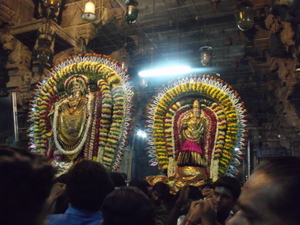
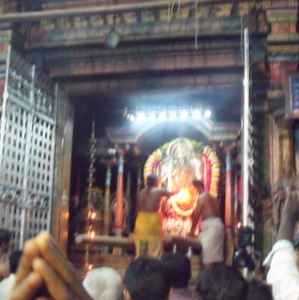
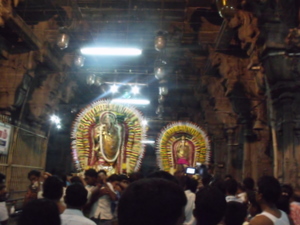
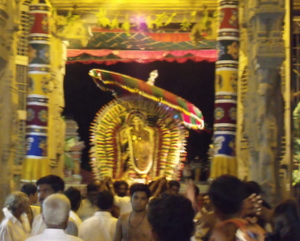
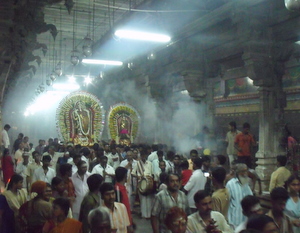
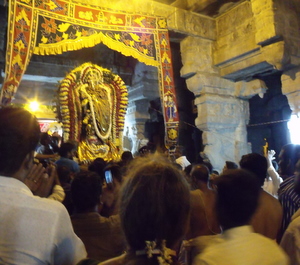
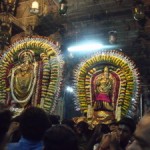
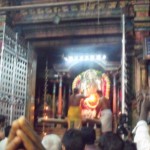 One of the festivals to Lord Nataraja is the Thirumanjanam festival celebrated during the tamil month of Aani (sanskrit=Jayeshta). In the main temple of Lord Arunachaleswara, the deities of Lord Nataraja and
 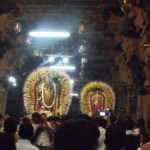 his consort Goddess Shivakami are brought out in procession with great fanfare and taken to the 1000 pillared hall where they are installed in a special shrine.
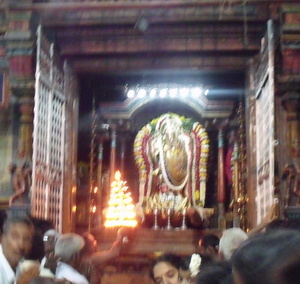
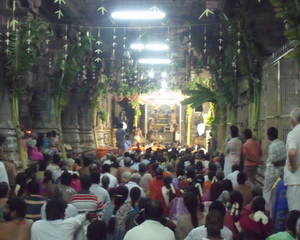
Interestingly the 3 tamil saivaite saints whose shrine faces the Nataraja shrine are also revered at the same time. Before the Nataraja and Shivakami
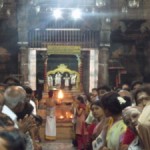 deities leave on procession, deeparadhana is performed for both the shrines facing each other and the crowd of devotees crane their necks this side and
 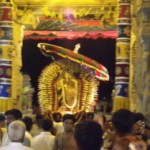 that side to take dharhsan of both the arathi rites which the priests perform simultaneously one to the other. This is known as the Arakattu Utsavam
 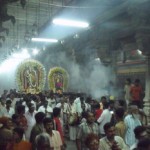 and only happens at this time.
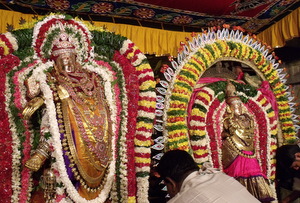 After Lord Nataraja and Goddess Shivakami are installed in the new shrine inside the 1000 pillared hall, the next day, early morning at dawn, a
 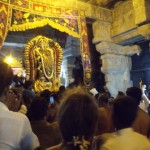 wonderful abhishekam, the actual “thirumanjanam” rite (literally meaning sacred bath) is performed and the deities are worshipped with alamkaram, karpuraratti and deeparadhana.
continue reading
-
Vaikasi Amavasai
 The new moon in the month of Vaikasi is Vaikasi Amavasai. This happens to be an important
  occasion in the big temple of Arunachaleswara and one of the grandest abhishekams of the year is
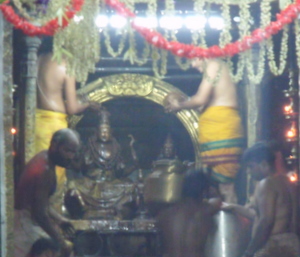
  celebrated to the Utsava Murthy, Lord Shiva-Somaskanda (whose shrine is in the left corridor of the inner mandapam of the main sanctum). The ceremonies start early in the morning with Rudra japa and Mahanyasam during which the kalasams and all the abhishekam elements are consecrated.
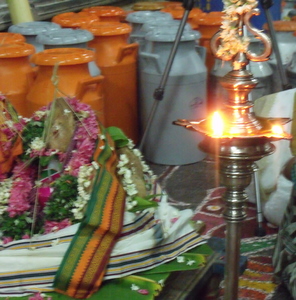
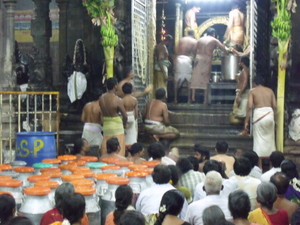
After this, the Maha Abhishekam is begun. It is indeed an impressive array. There are about 5000
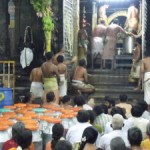 litres of milk in cans. Hundreds of pots of sandalwood paste, ghee, curd, honey, turmeric and rose water are kept in front of the deities. Flower garlands and flowers dear to
 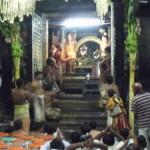 Lord Shiva are heaped in the side aisles for the alamkaram to the Gods. Fruits of the trinity, mangoes, bananas, jackfruits and also pomegrenates, dates and coconuts are brought in baskets. The Brahmin Archaka
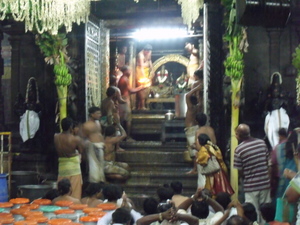
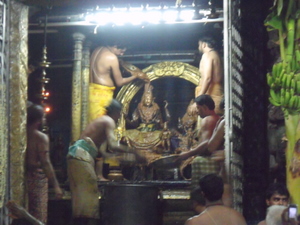
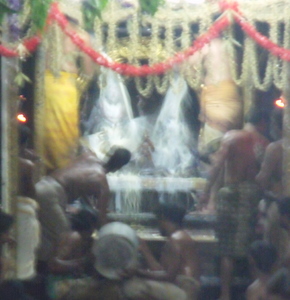
 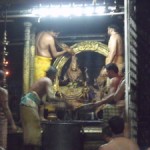 priests work with tireless energy carrying the hundreds of pots to the pedestal where they are received with devotion by the Gurukkal brahmin priests who then bathe the gods elaborately with the different elements. The devotees who are assembled to watch
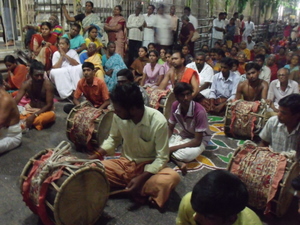
 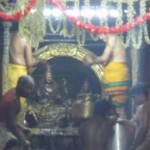 the Abhishekams are overcome by spiritual fervour every time the milk or curd or honey or ghee is poured on the deities, and as it gently flows down, the air is charged with sacred enthusiasm and devotional energy. The temple musicians play
 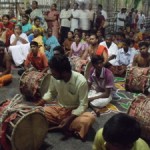 unstintingly throughout the celebration which takes place for upto over 8 hours.
 The Arunachaleswara temple of Tiruvannamalai stands as a towering pillar in the beautiful and elaborate manner with which they perform all the ceremonies due to the
  Gods and thus celebrate and preserve ancient sacred traditions. Be it rain or sun, the Gods here are always honoured properly at all the appropriate occasions.
continue reading
-
Mahapuja in Sri Ramanashram
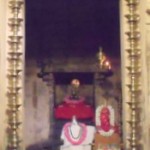 The anniversary of the mahasamadhi day of Bhagavan Ramana Maharshi’s mother is celebrated as Mahapuja inside the Mathrabhuteswara shrine in Ramanashram where her mortal remains were interred.
Bhagavan said, “mother said she would not leave me and go anywhere else. If she went anywhere she was afraid that she might die there. She was particular that she should die in my hands. She used to say, “even if you throw away my dead body in these thorny bushes i would not mind but i must end this life in your arms”.
In 1922 mother’s health broke down. On the festival of Bahula Navami, which fell that year on May 19th, it was obvious her end was near. After his usual morning walk Bhagavan entered mother’s room and waited on her the whole day, even taking his afternoon meal in the room. About sunset the evening meal was prepared and Bhagavan asked the others to eat, but he himself did not. In the evening the devotees sat beside mother in 3 separate groups singing the marital garland of letters. For a further 2 hours she lay there, her chest heaving and her breath coming in loud gasps; all this while Bhagavan sat beside her, and during the last hour he laid his right hand on her heart and his left on her head. There was no question of prolonging life but only of quieting the mind so that death could be Mahasamadhi, absorption in the Self. Later Bhagavan explained, “innate tendencies (vasanas) and the subtle memory of past experiences leading to future possibilities became very active. Scene after scene rolled before her in the subtle consciousness, the outer senses having already gone. The soul was passing through a series of experiences, thus avoiding the need for rebirth and so effecting union with Supreme Spirit. The prana was absorbed in the
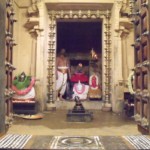
heart and the soul was at last disrobed of the subtle sheaths before it reached the final destination, the Supreme Peace of Liberation from which there is no return to ignorance”.
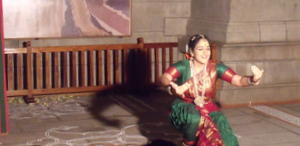
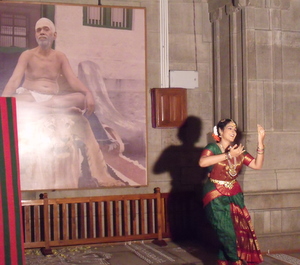
This year the Ramansahram celebrated Mahapuja on Sunday, 6th June. On Saturday evening, devotees enjoyed a Bharathnatyam recital by Vaishnavi Poorna, depicting various spiritual incidents in the life of the mother connected to her Son.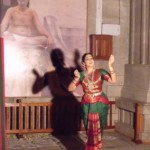
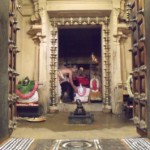 On Sunday morning, the grand Ekadasa Rudram puja-abhishekam was performed in the mother’s shrine with great splendour. The same evening, students of the Ramana Maharshi centre for learning in Bangalore presented a group dance event titled “Adhuvey Sthalam” portraying the life of
 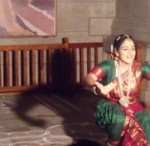 Alagammal, the mother of Ramana.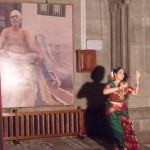
continue reading