Month April
-
Vasantha Utsavam, the Spring festival – Part I – a curtain raiser
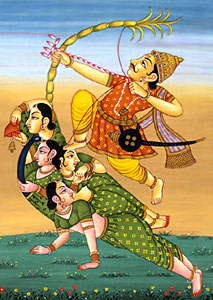
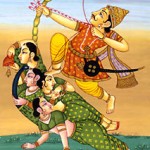 In Tiruvannamalai, the Vasantha Utsavam is celebrated to commemorate the momentous events that took place one fateful spring morning thousands of years ago, when Kama, the God of Love, decided to wield his Cupid´s bow and fire a flowery arrow into the heart of Lord Shiva himself who sat in deep meditation. Shiva, thus aroused, becomes furious and burns poor Kama to ashes with the flames of wrath leaping out of his third eye. Much later, Rathi the celestial consort of Kama appeals to Shiva in tearful agony and Shiva moved by her distress resurrects Kama out of the ashes.
This festival is celebrated alternately in the popular quarters of the town of Tiruvannamalai and inside the big temple of Arunachaleswara under the auspices of an Utsavam. In the town it is celebrated in 5 or 6 minor shrines dedicated to Devi or Subramanya. About two months prior to this, on the day of Masi Magam, a staff with a green standard is planted in the earth near the temple. To the bottom end of the staff is attached a pat of dried cow dung which bears the vaishnavite symbol of Kama. Although it is not used otherwise than in this ceremony, the pat of cow dung is the symbol representing the burning of Kama to ashes by the fire of Shiva. Following this incident, 10 days before the full moon of Chithirai, a little group of devotees from each temple march across the town in the evening bearing a tambour and a flag depicting Kama in the process of striking his arrows. They go from street to street singing the mournful strains of the Oppari (funeral) chant. Moreover, interspersed with the chanting, they recite the amorous exploits of Kama in coarse dialect. On the 10th day which is the full moon, an effigy of Kama made of lemon grass is dragged on the streets and burnt early in the morning in the presence of a character dressed up as Rathi and another dressed up as Shiva in meditation under the trees.
However, in the temple celebration, Kama is always resurrected, 3 or 5 days after his death. And with this idea, the ashes are collected in a little mound and in the midst of chanting Rathi pours milk on them as is wont in funerals. In some cases Shiva also gives a stick to Rathi with which to beat on the ashes thus showing that the Lord has accepted the appeal of the wife and that it is He who thus accords to Kama the right to live again.
In the temple also the festival is celebrated just after the vernal equinox which corresponds to midday of the gods day. It is notable that the 10th and final day of the festival coincides with the full moon of Chithirai in conjunction with the Chaithra constellation.
The preparations for the festival in the big temple consist of the following ceremonies:
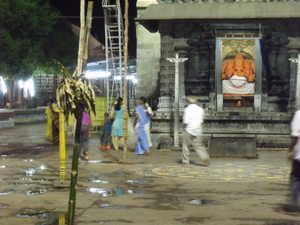
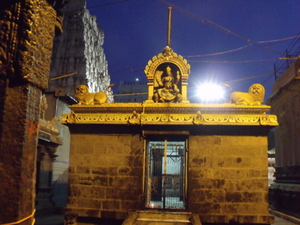
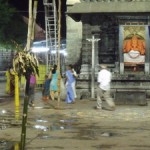 – the pandalkal muhurtam or the auspicious moment for defining the sacred space of the festival by the ritual of erecting the pandalkal or pandal pole. This is done in front of the shrine of the Sambandha Vinayagar who is freshly anointed with vermillion and showered with abhishekas for the occasion. Here on the ground the pandalkal decorated with mango leaves and flower garlands is firmly planted inside a pit which has been dug and consecrated earlier with bhumi puja ritual. After the pole is erected, diparadhana and arathi are performed.
– the Yagasalai or hall of sacrifice is opened on the first day in the evening after the sayarakshai ritual.
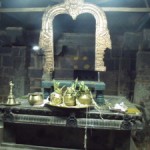
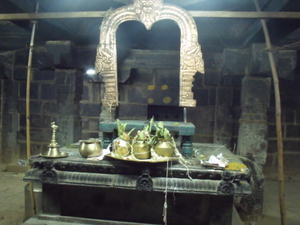
Here on the central platform, two kalasams, one representing Soma and the other Kama, have been placed on a mound of rice. The kalasams in this case are bronze pots filled with turmeric water and a coin, they are closed with a coconut surrounded by mango leaves crested by a knot of Dharba grass and decorated with a flower garland. Around the kalasam representing Soma, there are five palikai, little earthen pots in which the Navadhanya or the nine classic food grains have been germinated.
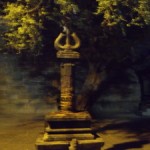 The soil in the pots comes from the ground beneath the Vilva tree which grows near the shrine of Goddess Pidari amman. Puja is performed to the kalasams twice daily during the 10 day period of the festival.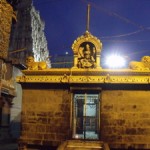
– A Kappu or protection bracelet is tied around the arm of god Somaskanda just after the first ritual in the yagasala.
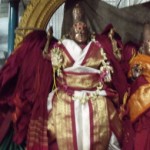
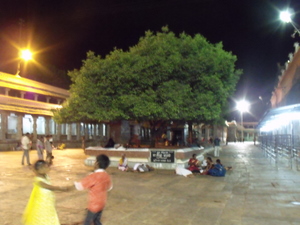
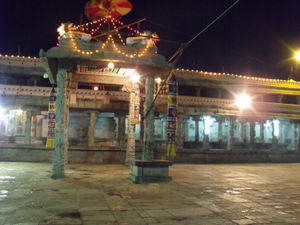
The specific rituals of the Vasantha festival: They are connected to the Southern area of the 3rd courtyard of the temple where there are the three Makila (mimusops elangi) trees, (the sthala viruksha or sacred/special tree of Arunachala), as well as to the divine marriage hall or kalyana mandapam.
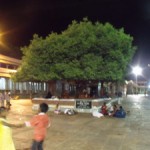
– the deities who are installed in shrines under the trees receive abhishekam and karpuratti puja daily twice during the 10 days.
 – inside the marriage hall right at the back, the Bhimaswera lingam is also venerated with abhishekam and puja during all the 10 days whereas this lingam is never venerated at any
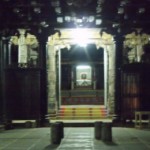 other time of the year. Interestingly the name of this lingam, Lord Bhima refers to the third brother of the Pandavas in the epic of Mahabharatham and it is he who gives Kama, the desire, the precedence over the three other goals of man (purusharthas)
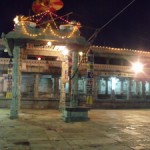 The principal and most attractive feature of the festival are the 10 splendid nightly tours of the god Somaskanda around the Makila trees with music and dance accompaniements and fanfare for the first 9 days of the festival. On the 10th day which falls on the full moon, the gods will go on a tirthavari procession to Ayyamkulam (ritual of the gods taking holy dip in a sacred pool) and on their return will take place the burning of Kama enacted in the form of an elaborate divine charade.
The celebration of the Vasantha festival dates back to very ancient times as learnt from the Bhavisyottara purana. Our next post will describe the actual proceedings of the festival with photos.
continue reading
-
Who am I? How is it to be found? from Talks with Sri Ramana Maharshi
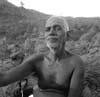 M.: Ask yourself the question. The body (annamaya kosa) and its
functions are not ‘I’.Going deeper, the mind (manomaya kosa) and its functions are not ‘I’.
The next step takes on to the question. “Wherefrom do these thoughts arise?” The thoughts are spontaneous, superficial or analytical. They operate in intellect. Then, who is aware of them? The existence of thoughts, their clear conceptions and their operations become evident to the individual. The analysis leads to the conclusion that the individuality of the person is operative as the perceiver of the existence of thoughts and of their sequence. This individuality is the ego, or as people say ‘I’. Vijnanamaya kosa (intellect) is only the sheath of ‘I’ and not the ‘I’ itself.
Enquiring further the questions arise, “Who is this ‘I’? Wherefrom does it come?” ‘I’ was not aware in sleep. Simultaneously with its rise sleep changes to dream or wakefulness. But I am not concerned with dream just now. Who am I now, in the wakeful state? If I originated from sleep, then the ‘I’ was covered up with ignorance. Such an ignorant ‘I’ cannot be what the scriptures say or the wise ones affirm. ‘I’ am beyond even ‘Sleep’; ‘I’ must be now and here and what I was all along in sleep and dreams also, without the qualities of such states. ‘I’ must therefore be the unqualified substratum underlying these three states (anandamaya kosa transcended).‘I’ is, in brief, beyond the five sheaths. Next, the residuum left over after discarding all that is not-self is the Self, Sat-Chit-Anand
continue reading
-
Tamil New Year
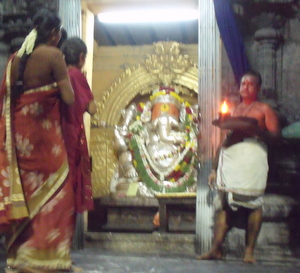 Tamil Nadu and Kerala are the only regions in India which follow the lunar calendar year (Chandra varusham) unlike the other regions which mostly follow the solar calendar year (Ravi varusham). The Tamil New year is born in the middle of April which is the first day of the month of Chithirai according to the Tamil calendar and it always begins on the new moon (Amavasya). People celebrate the new year like a religious festival and in Tiruvannamalai too, on this day they do giri pradakshina, perform pujas and religious ceremonies in their homes and then go to temples to worship the Lord.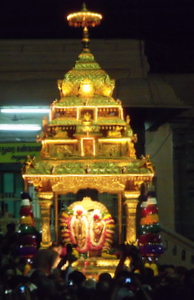
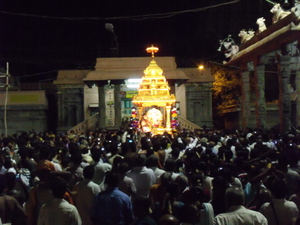
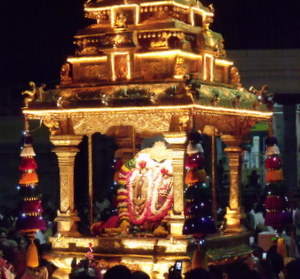
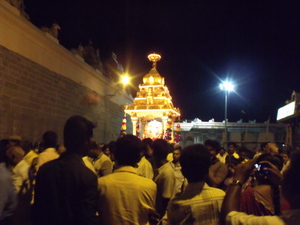
In the big temple of Lord Arunachaleswara, the beautiful golden chariot is taken out in honour of this day and the God and Goddess ride out on procession in all their magnificence and splendour. It is indeed a wondrous sight to see the Gods bedecked with jewels and flowers, seated majestically inside the chariot of pure gold and the air is rent with loud exclamations of wonder and piety as the chariot makes its way, around the vast courtyard of the temple, pulled by hundreds of earnest hands.
Earlier, the chief priest of the temple has read out the ‘Panchangam’ (traditional tamil almanac) with various predictions and auspicious interventions. The year born today is called ‘Vikruthi’. During the course of the month, the Nakshatra (constellation) Tiruvonam will be consecrated to Lord Nataraja and that of Satayam to the tamil saivaite saint Appar. But the main festival of the month is of course Vasantha, the spring festival which is dedicated to the death and resurrection of Sri Kama deva, god of desire. The spiritual significance of this is the destruction of worldly desire in order to give rise to the pure desireless being.

continue reading
-
Girivalam shrines – Kannappa temple
 The Kannappa temple is situated on the Girivalam inner path but it is also accessible from the outer path by means of a little forest trail near the Echo mandapam. Set with Arunachala as a backdrop, this temple is a scenic and quiet spot, ideal for meditation and is built at an altitude with a fine view of the forest and hill. It was falling into ruins some years ago and was renovated to its present state by the Shantimalai foundation. Today it appears as a beautiful stone monument with carved stone pillars in front and a fine stone staircase leading up to the shrine.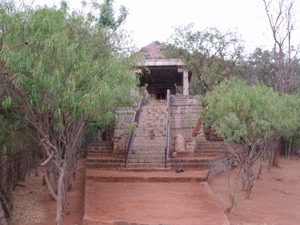
As the name suggests, this temple is dedicated to Sri Kannappa Nayanar who is one of the 63 Tamil Saivaite saints. Legend has it that Kannappa was a hunter in the forest and an ardent devotee of Lord Shiva. Everyday he would worship a Shiva Lingam in the forest with great devotion and piety. One day the Lord decided to test his faith and made the left eye on the Lingam to bleed copiously. When Kannappa saw this, he was so distressed that he pulled out his own left eye out of its socket and placed it on the bleeding eye on the Lingam. When he did this, the Lord made the other eye on the Lingam to bleed too and on seeing this, Kannappa even more pained, started to pull out his other remaining eye out of its socket to place it on this bleeding eye after first marking the spot with his foot because he knew he would be unable to see if he pulled out his other eye. At this point, Lord Shiva, greatly moved by his devotion, appears to Kannappa there and holds his hand. Thus Kannappa’s devotion is rewarded and he is granted liberation. Till today he is revered as one of the 63 holy savants of Tamil saivism even though he was only a simple huntsman.
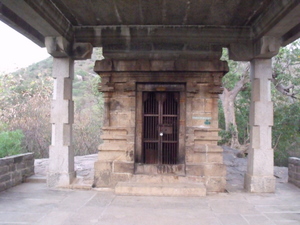 The Kannappa temple also plays a role in the Thiruvoodal festival in January which is the Divine quarrel between Lord Shiva and Goddess Parvathi. During this event, the jewels of the Gods are supposedly stolen and this episode of the ‘Divine Jewels robbery’ takes place, interestingly, inside the Kannappa temple where it is enacted every year in the form of a divine drama ritual.
continue reading
-
Panguni Uttaram – the Divine Marriage
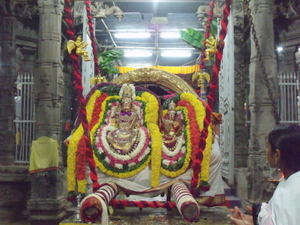 The full moon of the tamil month of Panguni in conjunction with the lunar constellation of Uttaram (meaning that which is superior, excellent) is presided by the ViswaDeva (meaning totality of the Gods). The fullness of the moon, the excellence of the constellation and the divine totality all give this day the qualities of completion and perfection.
In Tiruvannamalai, on this day, the marriage of Lord Shiva and Goddess Parvathi is celebrated. The marriage celebrations last for 6 days and the programme is as follows: 1st day – Panguni Uttaram, celebration of the bethrothal ceremony. 2nd day – Maru Unnal Utsavam, feast of taking meals in the in-laws house. 3rd, 4th and 5th days – Nalangu Unjal, ceremony of ritually rocking the Gods seated upon a wooden swing. 6th day – Manjal Nirattu vizha, ceremony of the ritual bath in turmeric water.
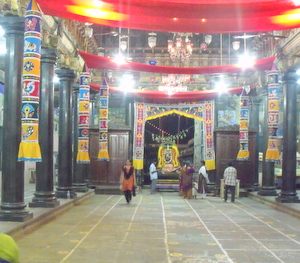 At the outset, the marriage invitation is printed and distributed to all the town folk. Curiously the marriage ceremony is performed twice. In the morning it happens inside the inner sanctum of the resident chief deity (Moolavar-lingam) and in the evening it is celebrated for the Utsava murthys (the ambulant Gods or the deities in procession).
Morning: the marriage ceremony is begun with the usual daily rituals performed to the lingam. During the course of the rituals, the gold-jewelled symbol of marriage (thali or mangalyam) is tied around the neck of the Goddess Bhogasakthi represented by a bronze statue who is always present in the ante-chamber of the sanctum.
Afternoon: Around 4 p.m. the Goddess Thani Amman is borne in procession to the Kumaran temple situated at the South of the big temple where She is installed on a pedestal.
Night: Around 10 p.m. after a very elaborate ritual of decoration, the Goddess adorned in her marriage sari is borne back in procession to the shrine in the 3rd courtyard of the big temple where Lord Shiva awaits her in the form of Somaskanda (Shiva as a husband). Now, to the delight of the spectators, a graceful ballet ritual ensues, during which the two deities (Thani Amman and Somaskanda) borne upon devotees’ shoulders are brought close thrice, one to the other, and the marital garlands are exchanged thereby. Then the bridal couple deities are carried to the marriage hall on the South of the 3rd courtyard where devotees are gathered already to witness the marriage celebration. Here the Gods are installed on a beautiful wooden old fashioned swing. At their feet, two kalasams representing the bridal couple have been consecrated and decorated. We also see various other symbols of marriage – germinated grains sprouting in 5 little earthen pots, mortar and pestle etc. The main ceremony begins around midnight. There takes place firstly a series of general marriage rituals:
– a protection braclelet (kappu or kanganam) is tied around the waist of each.
– after a divine chanting, a sacred cord (Yajnopavita) is offered to the god.
– the thali or mangalyam (the sacred cord of marriage with gold-jewelled ornament) is then tied around the neck of the Goddess.
– the priests perform a very elaborate fire sacrifice (agni homa). This sacrificial fire is conserved in a clay pot and is kept burning for 5 days.
The end of the marriage consists of a puja, with offering of naivedya (food offering) to the fire, to the kalasams and to the deities.
Very late at night around 2 a.m. the celebration continues with a very lighted procession around the 4 streets of the temple and this goes upto dawn. On their return, around 7 a.m. the bridal couple, Somaskanda and Thani Amman resume their places in the marriage hall and are worshipped with Abhishekams (sacred ritualistic baths for the deities).
 Thus the divine marriage serves as a reminder to men that the marriage of the gods is a model of that of men and that conjugal life is a source of happiness and prosperity.
continue reading