Existence or consciousness is the only reality. Consciousness plus waking we call waking. Consciousness plus sleep we call sleep. Consciousness plus dream we call dream. Consciousness is the screen on which all the pictures come and go. The screen is real, the pictures are mere shadows on it.
The Self and the appearances therein, as the snake in the rope, can be well illustrated like this. There is a screen. On that screen first appears the figure of a king. He sits on a throne. Then before him on that same screen a play begins with various figures and objects, and the king on the screen watches the play on the same screen. The seer and the seen are mere shadows on the screen which is the only reality, supporting all the pictures. In the world also, the seer and the seen together constitute the mind, and the mind is supported by or based on the Self.
The ajata school of Advaita says, ‘Nothing exists except the one reality. There is no birth or death, no projection or drawing in, no sadhaka (aspirant), no mumukshu (one who desires to be liberated), no mukta (one who is liberated), no bondage, no liberation. The One Unity alone exists forever.’ To those who find it difficult to grasp this truth and ask, ‘How can we ignore this solid world we see all around us?’ the dream experience is pointed out and they are told, ‘All that you see depends on the seer. Apart from the seer there is no seen.’ This is called drishti-srishti vada, or the argument that one first creates out of his mind and then sees what his mind itself has created.
To those who cannot grasp even this and who further argue, ‘The dream experience is so short, while the world always exists. The dream experience was limited to me. But the world is felt and seen not only by me but by so many and we cannot call such a world nonexistent,’ the argument called srishti-drishti vada is addressed and they are told, ‘God first created such and such a thing out of such and such an element and then something else and so forth.’ That alone will satisfy them. Their minds are not otherwise satisfied and they ask themselves, ‘How can all geography, all maps, all sciences, stars, planets and the rules governing or relating to them, and all knowledge be totally untrue?’ To such it is best to say, ‘Yes. God created all this and so you see it.’ All these are only to suit the capacity of the hearers. The absolute can only be one.
There is first the white light, so to call it, of the Self, which transcends both light and darkness. In it no object can be seen. There is neither seer nor seen. Then there is also total darkness (avidya) in which no obj ects are seen. But from the Self proceeds a reflected light, the light of pure mind (manas), and it is this light which gives room for the existence of all the film of the world, which is seen neither in total light nor in total darkness, but only in the subdued or reflected light.
From the point of view of Jnana (Knowledge) or the Reality, the pain seen in the world is certainly a dream, as is the world, of which any particular pain like hunger is an infinitesimal part. In the dream also you yourself feel hunger. You see others suffering from hunger. You feed yourself, and moved by pity feed the others whom you find suffering from hunger. So long as the dream lasted, all those pains were as real as you now think the pain in the world to be. It was only when you woke up that you discovered that the pain in the dream was unreal. You might have eaten to the full and gone to sleep. You dream that you work hard and long in the hot sun all day, are tired and hungry and want to eat a lot. Then you wake up and find your stomach is full and you have not stirred out of your bed. But this does not mean that while you are in the dream you can act as if the pain you feel is not real. The hunger in the dream has to be assuaged by the food in the dream. The fellow beings you found so hungry in the dream had to be provided with food in that dream. You can never mix up the two states, the dream and the waking state. Till you reach the state of jnana and thus wake out of maya you must do social service by relieving suffering whenever you see it. But even then you must do it without ahankara, i.e., without the sense of ‘I am the doer’, but with the feeling ‘I am the Lord’s tool’. Similarly one must not be conceited by thinking, ‘I am helping a man below me. He needs help. I am in a position to help. I am superior and he inferior.’ But you must help the man as a means of worshipping God in that man. All such service is for the Self and not for anybody else. You are not helping anybody else, but only yourself.
The book Kaivalya Navaneeta has asked and answered six questions on maya. They are instructive:
1. What is maya? The answer is: It is anirvachaniya or indescribable.
2. To whom does it come? The answer is: To the mind or ego who feels that he is a separate entity, who thinks ‘I do this’ or ‘This is mine’.
3. Where does it come from and how did it originate? The answer: Nobody can say.
4. How did it arise? The answer is: Through non-vichara, through failure to enquire ‘Who am I?’
5. If the Self and maya both exist, does this not invalidate the theory of Advaita? The answer is: It need not, since maya is dependent on the Self as the picture is on the screen. The picture is not real in the sense that the screen is real.
6. If the Self and maya are one, could it not be argued that the Self is of the nature of maya and that it is also illusory? The answer is: No, the Self can be capable of producing illusion without being illusory. A conjuror may create for our entertainment the illusion of people, animals and things, and we see all of them as clearly as we see him, but after the performance he alone remains and all the visions he created have disappeared. He is not a part of the vision but solid and real.
The books use the following illustration to help explain creation: The Self is like the canvas for a painting. First a paste is smeared over it to close the small holes that are in the canvas. This paste can be compared to the Antaryamin (Indweller) in all creation. Then the artist makes an outline on the canvas. This can be compared to the sukshma sarira (subtle body) of all creatures; for instance, the light and sound (bindu and nada) out of which all things arise. Within this outline the artist paints his picture with colours, etc., and this can be compared to the gross forms that constitute the world.
Vedanta says that the cosmos springs into view simultaneously with the seer. There is no creation by stages or steps. It is similar to the creation in dream where the experiencer and the objects of experience come into existence at the same time. To those who are not satisfied with this explanation, theories of gradual creation are offered in books.
It is not at all correct to say that advaitins of the Sankara school deny the existence of the world, or that they call it unreal. On the other hand, it is more real to them than to others. Their world will always exist whereas the world of the other schools will have origin, growth and decay, and as such cannot be real. They only say that the world as ‘world’ is not real, but that the world as Brahman is real. All is Brahman, nothing exists but Brahman, and the world as Brahman is real.
The Self is the one Reality that always exists, and it is by the light of the Self that all other things are seen. We forget it and concentrate on the appearance. The light in the hall burns both when persons are present and when they are absent, both when persons are enacting something, as in a theatre, and when nothing is being enacted. It is the light which enables us to see the hall, the persons and the acting. We are so engrossed with the objects or appearances revealed by the light, that we pay no attention to the light. In the waking or dream state in which things appear, and in the sleep state in which we see nothing, there is always the light of Consciousness or Self, like the hall lamp which is always burning. The thing to do is to concentrate on the seer and not on the seen, not on the objects, but on the Light which reveals them.
Questions about the reality of the world, and about the existence of pain or evil in the world, will all cease when you enquire ‘Who am I?’ and find out the seer. Without a seer the world and the evils thereof alleged do not exist.
The world is of the form of the five categories of sense objects, and nothing else. These five kinds of objects are sensed by the five senses. As all are perceived by the mind through these five senses, the world is nothing but the mind. Is there a world apart from the mind?
Though the world and consciousness emerge and disappear together, the world shines or is perceived only through consciousness. That source wherein both these arise and disappear, and which itself neither appears nor disappears, is the perfect Reality.
If the mind, the source of all knowledge and activity subsides, the vision of the world will cease. Just as knowledge of the real rope does not dawn till the fancied notion of the serpent disappears, vision (experience) of the Reality cannot be gained unless the superimposed vision of the universe is abandoned.
That which really exists is only the Self. The world, jiva (individual self) and Iswara (God) are mental creations, like the appearance of silver in mother of pearl. All these appear at the same time and disappear similarly. The Self alone is the world, the ego and Iswara.
To the jnani it is immaterial whether the world appears or not. Whether it appears or not, his attention is always on the Self. Take the letters and the paper on which they are printed. You are wholly engrossed with the letters and have no attention left for the paper. But the jnani thinks only of the paper as the real substratum, whether the letters appear or not.
You make all kinds of sweets from various ingredients and in various shapes, and they all taste sweet because there is sugar in all of them, and sweetness is the nature of sugar. In the same way, all experiences and the absence of them contain the illumination, which is the nature of the Self. Without the Self they cannot be experienced, just as without sugar not one of the articles you make can taste sweet.
The Immanent Being is called Iswara. Immanence can only be with maya. It (Iswara) is the Knowledge of Being along with maya. From the subtle conceit Hiranyagarbha rises; from Hiranyagarbha the gross, concrete Virat rises. Chit-Atma is pure Being only.
As regards the existence of pain in the world, the wise one explains from his experience, that if one withdraws within the Self there is an end of all pain. The pain is felt so long as the object is different from oneself. But when the Self is found to be an undivided whole, who and what is there to feel?
The Upanishadic text ‘I am Brahman’ only means Brahman exists as ‘I’.
– Gems from Bhagavan
Share
continue reading
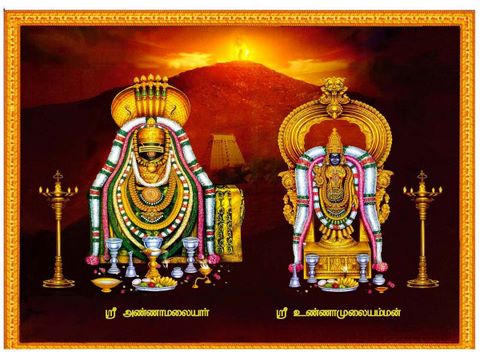
 Tiruvoodal is the divine quarrel between Shiva and Parvathi and it is celebrated in Tiruvannamalai during the month of January, the second day after Pongal. In fact there is a whole street close to the temple called ‘Tiruvoodal street’ where the main part of the festival, the divine quarrel or the Tiruvoodal itself, is enacted.
 the slopes of Arunachala, She would subsequently regain the favour of her Lord and be united with Him in the left half of His body (Ardhanaariswara) and this is what is realised on the day of Karthigai Deepam.
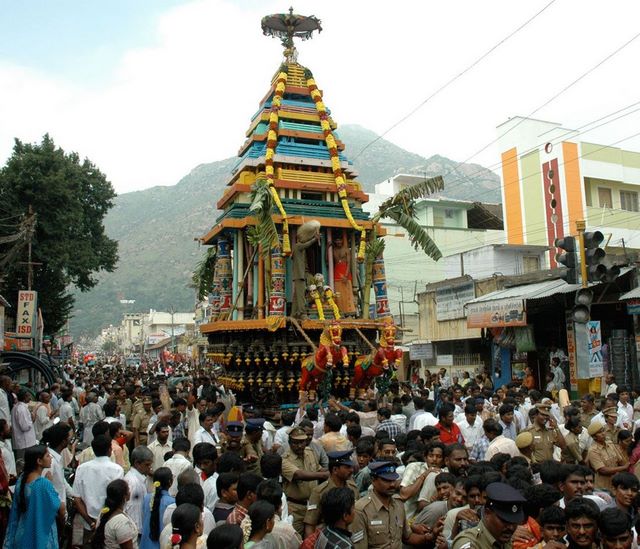
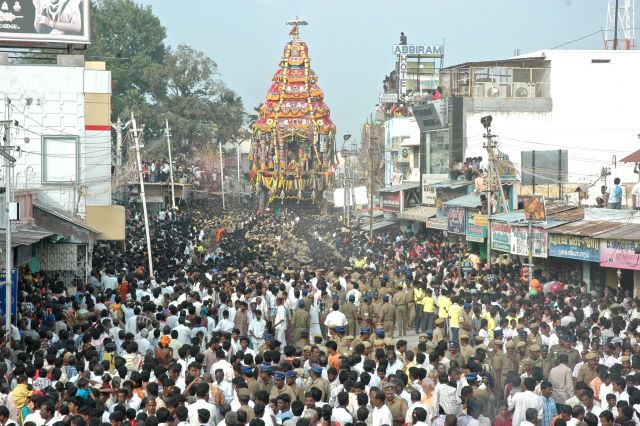
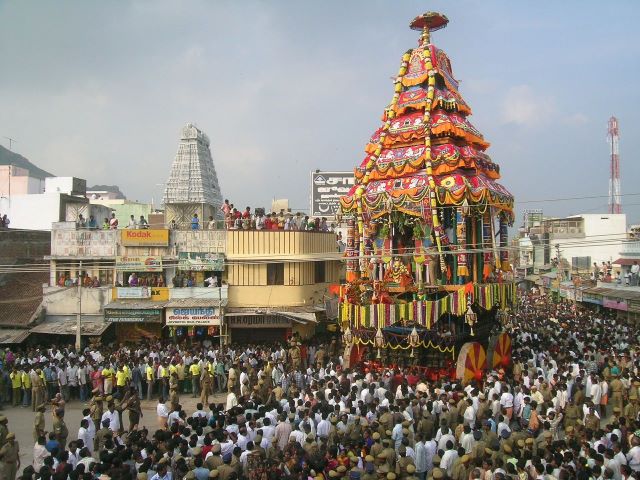
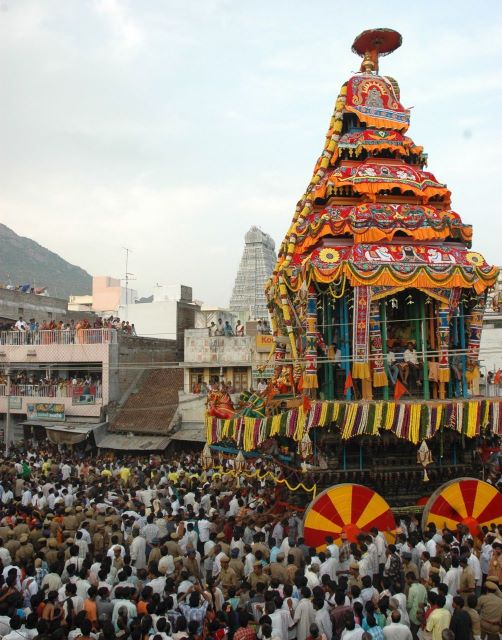
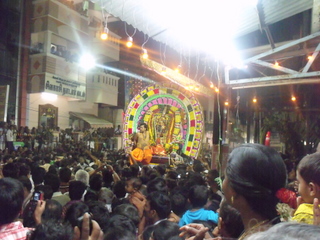 processions of the deities starting from the big temple and going on the four streets around the temple. The Utsava Murthis are Sri Mula Nayakar (Shiva in the form of Somaskanda), Tani Ambal (the independent goddess) and Sundaramurthi Nayanar (one of the main tamil saivaite saints).
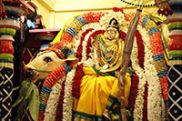
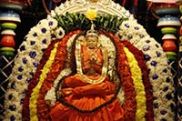
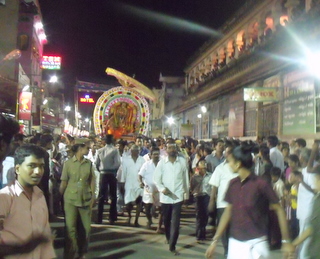 The most interesting part of the festival takes place in the evening on Tiruvoodal street. During this part, the quarrel between Shiva and His consort, Parvathi, is enacted in public on the streets and witnessed by a large gathering of devotees who are assembled there eagerly to watch the divine drama. The God and the Goddess are brought on palanquins from opposite ends of the street and then borne down to face each other. The narrative of the quarrel is chanted by an Oduvar (temple singer) in tamil lyrics. After this ensues a
  dramatic dancing procession. Six times the God and the Goddess are borne down at a great speed and then meet in the centre and
  have their quarrel. This is played out by the palanquin bearrers jumping and shaking the palanquin up and down, which makes it appear as if the deity inside is jumping up and down in a fit of rage. The temple musicians play their drums in fitting accompaniment, adding to the frenzied rantings of the gods as they are shouting at each other. After each quarrel-dance, the deities change sides and each goes off in the opposite direction from which he or she came initially. The crowds of devotees are hysterical with excitement and after each dance-quarrel, the tension mounts and so do the loud cries of fervor and devotion which increase in volume and fury.
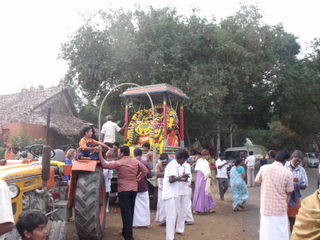 a halt at the Vedarpari mandapam where his jewels are supposedly stolen and later on he also grants salvation to his ardent devotee Kannappa. This is the reason for the Kannappa temple on that location. Shiva also grants darshan to another of his devotees the great rishi ‘Bhringi’ during this trip. Shiva eventually completes his giri pradakshina and returns to the temple in the afternoon where he enters, dancing the dance of the Swan (Hamsa Natanam). The bearers of the palanquins have a special technique to execute this dance and it causes a type of swaying, continuous oscillation of the deity without losing balance, quite a fascinating sight!
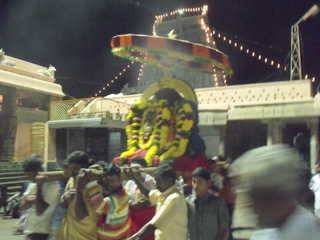 sanctum sanctorum. Sundaramurthi Nayanar first goes to warn the Goddess about the return of Shiva. Of course, She, being curious, leaves Her door open so that She can have a glimpse of the dancing arrival of Her Lord. On seeing this spectacle, however, She is so dazzled by her Lord’s beauty and splendour as He arrives
 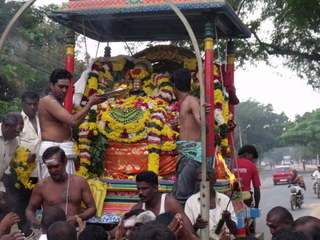 majestically doing His swan-dance, that She submits to Him and wishes to be re-united. Thus the reconciliation and reunion of the gods take place and to celebrate this, both the deities are brought together and placed on the same pedestal and the priests perform an Arathi puja waving and encircling one single flame around both of the deities to signify the restoration of harmony.